AAN 2026 | Research exploring the use of TACS and TMS in the treatment of post-stroke aphasia
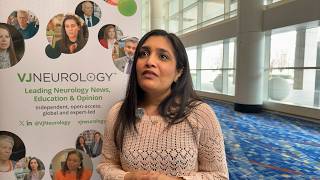
Priyanka Shah-Basak, PhD, Medical College of Wisconsin, Milwaukee, WI, discusses research exploring the use of neuromodulation techniques, including transcranial alternating current stimulation (TACS) and transcranial magnetic stimulation (TMS), to improve language outcomes in individuals with post-stroke aphasia. This interview took place at the 78th American Academy of Neurology (AAN) Annual Meeting in Chicago, IL.
These works are owned by Magdalen Medical Publishing (MMP) and are protected by copyright laws and treaties around the world. All rights are reserved.
Transcript
So I just talked about different types of neuromodulation techniques. And so in my lab, which is the Cognition and Brain Stimulation Lab at the Medical College of Wisconsin, we have studies where we’re using transcranial alternating current stimulation, so that’s a type of electrical stimulation that interacts with brain oscillatory activity. And what we’re doing with those studies in post-stroke aphasia patients in the chronic phases of recovery to collect evidence whether or not technology like TACS or alternating current stimulation can modulate that brain oscillatory activity and then have an impact on language outcomes...
So I just talked about different types of neuromodulation techniques. And so in my lab, which is the Cognition and Brain Stimulation Lab at the Medical College of Wisconsin, we have studies where we’re using transcranial alternating current stimulation, so that’s a type of electrical stimulation that interacts with brain oscillatory activity. And what we’re doing with those studies in post-stroke aphasia patients in the chronic phases of recovery to collect evidence whether or not technology like TACS or alternating current stimulation can modulate that brain oscillatory activity and then have an impact on language outcomes. We don’t know much about this technology. While there have been thousands and thousands of publications on TACS, its application in aphasia and post-stroke aphasia is relatively in its infancy. And so we have NIH funding to be able to collect some data in post-stroke aphasia as more proof-of-concept studies to look at short-term effects of this technology on verbal short-term memory outcomes. We also have funding to be able to use TMS, or transcranial magnetic stimulation, as a way of, it’s more of a longitudinal study where we are trying to optimize spatial targets using techniques such as functional neuroimaging and also different types of TMS to determine precision targets in post-stroke aphasia and see if that type of individualized targeting with speech-language therapy and TMS, and in this case excitatory TMS, can have an impact on word-finding abilities in functional communication.
This transcript is AI-generated. While we strive for accuracy, please verify this copy with the video.
Read more...