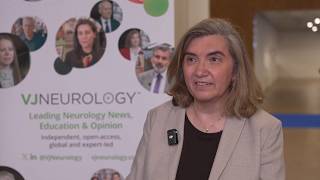
ACTRIMS 2026 | Predicting symptom onset in RIS using combined biomarker approaches
Raphael Schneider, MD, PhD, FRCPC, CIP, St. Michael’s Hospital, Toronto, Canada, discusses the importance of considering multiple biomarkers to predict the risk of a person with radiologically isolated syndrome (RIS) developing symptoms. Dr Schneider notes that his center is working on combining data from protein biomarkers and imaging to create a more accurate predictor of future risk. This interview is part of our coverage of the 11th Annual Americas Committee for Treatment and Research in Multiple Sclerosis (ACTRIMS) Forum, held in San Diego, CA.
These works are owned by Magdalen Medical Publishing (MMP) and are protected by copyright laws and treaties around the world. All rights are reserved.
Transcript
Yeah, absolutely interesting question, right spot on, because there are additional markers outside of the blood biomarkers that have been associated with the risk of a person with radiologically isolated syndrome or RIS to develop symptoms in the future and also to have worse looking MRIs in the future. And those would be, for example, what’s called paramagnetic rim sign lesions. And this is another study that’s actually been published recently from our center, where we’ve seen that if you look into this cohort over longer periods of time, so several years, then the baseline number of MRI lesions that show a paramagnetic rim will be important predictors for the future...
Yeah, absolutely interesting question, right spot on, because there are additional markers outside of the blood biomarkers that have been associated with the risk of a person with radiologically isolated syndrome or RIS to develop symptoms in the future and also to have worse looking MRIs in the future. And those would be, for example, what’s called paramagnetic rim sign lesions. And this is another study that’s actually been published recently from our center, where we’ve seen that if you look into this cohort over longer periods of time, so several years, then the baseline number of MRI lesions that show a paramagnetic rim will be important predictors for the future. So at this point, we’re actually doing exactly this type of work where we’re pulling in data from the protein biomarkers, but also from imaging to see if a combined imaging and protein biomarker would actually be the best predictor for the future. So that when patients come to the clinic, we would do on the one hand side the protein biomarkers, but also the MRI biomarkers to then better understand the risk without thinking about risk in a very siloed manner where we only consider the MRI or only consider the blood biomarkers. So those are now statistical models that we’re building to see if we can pick the right types of proteins out of that pool and the right type of imaging markers out of the pool of imaging markers to then come up with a combined marker, so to speak, to be more precise when it comes to estimating the risk.
This transcript is AI-generated. While we strive for accuracy, please verify this copy with the video.
Read more...

Disclosures
Dr Raphael Schneider has received consulting fees from Novartis and EMD Serono and payments or honoraria for lectures, presentations, and educational events from Biogen-Idec, Sanofi-Genzyme, EMD Serono, and Roche. Dr Schneider has participated on advisory boards for Novartis and EMD Serono. He has also received support for attending scientific meetings from EMD Serono.