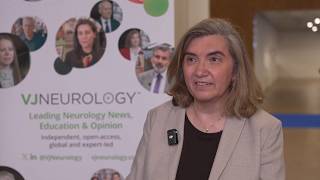
ACTRIMS 2022 | How does tDCS work in MS?
Leigh Charvet, PhD, New York University Grossman School of Medicine, New York, NY, discusses how transcranial direct current stimulation (tDCS), a non-invasive brain stimulation therapy, works in patients with multiple sclerosis (MS). Due to the non-specific nature of tDCS towards MS pathology, it is considered a symptomatic management technique – with the primary function being to improve the quality of life and partially remediate cognitive and motor impairments for individuals suffering from MS. The unknown nature of how the tDCS works on MS has initiated mechanistic studies in pair with neural imaging; this will help understand the mode of action the therapy has on individuals with MS, and also find potential signals to better predict who would benefit most from the therapy. This interview took place at the ACTRIMS Forum 2022 in West Palm Beach, Florida.

Disclosures
Prof. Charvet reports the following disclosures:
Funding: US Department of Defense & National Multiple Sclerosis Society