ECTRIMS 2025 | Highlights from ECTRIMS 2025: updated diagnostic criteria, novel therapies, & more
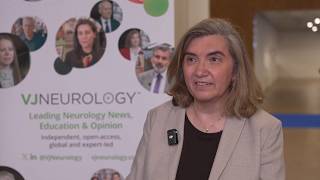
Celia Oreja-Guevara, MD, PhD, University Hospital San Carlos, Madrid, Spain, shares highlights from the 41st Congress of the European Committee for Treatment and Research in Multiple Sclerosis (ECTRIMS). She discusses the updated McDonald diagnostic criteria, the management of older patients, novel therapies, and the use of fluid biomarkers. This interview took place at the 41st Congress of the European Committee for Treatment and Research in Multiple Sclerosis (ECTRIMS) in Barcelona, Spain.
These works are owned by Magdalen Medical Publishing (MMP) and are protected by copyright laws and treaties around the world. All rights are reserved.
Transcript
In this ECTRIMS the most important highlight was the new criteria. Really we have now the publication of the new criteria the week before ECTRIMS so that in many different talks they presented the new criteria with the the fifth topography that is the optic nerve special characteristic to diagnosis the multiple sclerosis in patients over 55 years. The same criteria for children and adults. To use the positive CSF with the light kappa change instead of the oligoclonal bands...
In this ECTRIMS the most important highlight was the new criteria. Really we have now the publication of the new criteria the week before ECTRIMS so that in many different talks they presented the new criteria with the the fifth topography that is the optic nerve special characteristic to diagnosis the multiple sclerosis in patients over 55 years. The same criteria for children and adults. To use the positive CSF with the light kappa change instead of the oligoclonal bands. And a new sign in the MRI that is the central vein sign that we can use to confirm that if the patients have MS. So really was the most important highlight the new criteria and they were in different forms with clinical cases or in different explanations. The second point was aging so that the patients they are with more and more age and so we need to think to take this into account because these patients they have comorbidities they don’t have the same behavior with the treatments these patients they have another problems like some depression anxiety or some of them they have other diseases or really other more symptoms. And the other important point was what to do with patients to keep the treatment to deescalate the treatment or to stop the treatment so that aging was a big important subject. Another important subject was new treatments like for example the CAR-T in MS patients. For example some Phase II studies with frexalimab, with ridaforolimus, with foralumab. And the last point that was important is to use some fluid biomarkers such as neurofilament and GFAP to monitor the response of the treatments.
This transcript is AI-generated. While we strive for accuracy, please verify this copy with the video.
Read more...