AAN 2026 | Enhancing MS safety monitoring through national registry data: insights from ReMuS Czechia
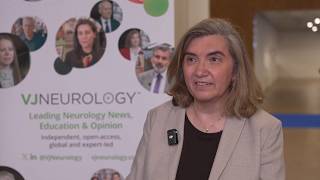
Dominika Stastna, MD, PhD, Charles University & General University Hospital, Prague, Czechia, discusses efforts to enhance safety monitoring in multiple sclerosis (MS) using the ReMuS Czech national MS registry. The registry includes a comprehensive collection of adverse events and comorbidities, providing meaningful insights into the safety of disease-modifying therapies. This interview took place at the 78th American Academy of Neurology (AAN) Annual Meeting in Chicago, IL.
These works are owned by Magdalen Medical Publishing (MMP) and are protected by copyright laws and treaties around the world. All rights are reserved.
Transcript
I just showed two analyses with data from the Czech National MS registry, ReMus. This registry is there from 2013, so there’s quite a long follow-up since then, and we cover more than 80 or 85 percent of Czech patients, and almost everybody with disease-modifying therapy. Both of those analyses show efficacy data, but you know that safety data are at least as important as efficacy, maybe even more...
I just showed two analyses with data from the Czech National MS registry, ReMus. This registry is there from 2013, so there’s quite a long follow-up since then, and we cover more than 80 or 85 percent of Czech patients, and almost everybody with disease-modifying therapy. Both of those analyses show efficacy data, but you know that safety data are at least as important as efficacy, maybe even more. And they are really a hot topic nowadays. So we decided to do a lot of effort to collect safety data. And we do it in two ways. One is via connection with the national reimbursement data collector, and we have administrative data from them, and this is something we can see in the North European registries, this is similar. But what’s really special in our registry, we started to collaborate on comorbidity collection with every MS center in the Czech Republic, and we collect also really mild, everything, really mild comorbidities, adverse events, and put everything together, and you know, cross-check, and so on. And now we have something like a whole picture about safety in disease-modifying therapies. For example, if we are speaking about the number of adverse events, we collected in the Czech Republic, in 2025, it’s something above 8,000, so definitely it’s a number, and we can do some analysis based on that. We just started, but I think then there can be really nice findings to show you guys next time, or on some conference. And we are really open to collaboration, if you want to work with us on this really interesting topic.
This transcript is AI-generated. While we strive for accuracy, please verify this copy with the video.
Read more...

Disclosures
Dr. Stastna has received personal compensation in the range of $500-$4,999 for serving on a Scientific Advisory or Data Safety Monitoring board for Biogen. Dr. Stastna has received personal compensation in the range of $500-$4,999 for serving on a Speakers Bureau for Biogen. Dr. Stastna has received personal compensation in the range of $500-$4,999 for serving on a Speakers Bureau for Novartis. Dr. Stastna has received personal compensation in the range of $500-$4,999 for serving on a Speakers Bureau for Roche. Dr. Stastna has received personal compensation in the range of $500-$4,999 for serving on a Speakers Bureau for Merck. Dr. Stastna has received publishing royalties from a publication relating to health care.