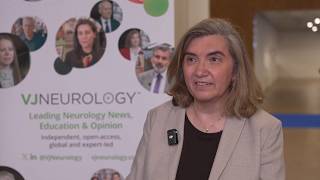
ECTRIMS 2025 | The safety and efficacy of additional cycles of cladribine in MS: insights from a real-world study
Celia Oreja-Guevara, MD, PhD, University Hospital San Carlos, Madrid, Spain, discusses the findings of a real-world study analyzing the use of cladribine in patients with multiple sclerosis, focusing on those who received additional cycles of the treatment. Prof. Oreja-Guevara highlights that approximately 45% of patients in years 5-7 of treatment received an additional cycle of cladribine, with 70% of these patients receiving a fourth course, and notes that these additional courses were efficacious with no new safety signals. This interview took place at the 41st Congress of the European Committee for Treatment and Research in Multiple Sclerosis (ECTRIMS) in Barcelona, Spain.
These works are owned by Magdalen Medical Publishing (MMP) and are protected by copyright laws and treaties around the world. All rights are reserved.
Transcript
So we have presented the poster of our clinical practice. It was a real-world study with our experience. We have analyzed the first 131 patients. And we have looked, we have a focus on the patients that are in the years 5 to 7. So that we have 59 patients in these years, between five to seven, and we have looked at what we have done with these patients. An important group, around 45% of these patients, they have received another additional cycle of cladribine...
So we have presented the poster of our clinical practice. It was a real-world study with our experience. We have analyzed the first 131 patients. And we have looked, we have a focus on the patients that are in the years 5 to 7. So that we have 59 patients in these years, between five to seven, and we have looked at what we have done with these patients. An important group, around 45% of these patients, they have received another additional cycle of cladribine. And from these patients, 70% of the patients, they have received a fourth course of cladribine. And the most important thing, these third and fourth courses, they were efficacious. So the patients, they have no more relapses. And the second important thing, there was nothing new with the safety. We have no more grade of lymphopenia. We have no more infections and we have no opportunistic infections. So that our finding was, we can use a third or fourth cycle of cladribine when the patients need it. And we don’t have, the efficacy is really very good. And we don’t have new safety signals. And one of the important things is why we have changed the treatment for the patients, why we have offered a new additional course of cladribine. Some of them, they were because they have very mild radiological activity. Some of them, because the patients, they were afraid to have a relapse and they have asked us to give them a treatment to prevent a relapse. And another group of patients, they were because they have what we say, minor symptoms, that they have complained about, more fatigue or worsening in their walk or perhaps they don’t feel good, so that is very unspecific minor symptoms that we have thought, okay, these patients, they can perhaps have a relapse, so that we have to decide to give another one, so that in general, they have tolerated it very well. And as I told before, the safety was really very good.
This transcript is AI-generated. While we strive for accuracy, please verify this copy with the video.
Read more...