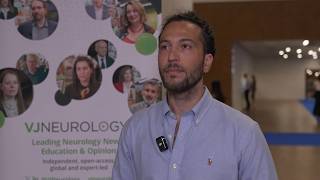
EAN 2026 | Genetic pathways associated with body-first and brain-first Parkinson’s disease
Massimiliano Passaretti, MD, PhD, Karolinska Institute, Solna, Sweden, discusses the genetic pathways associated with body-first and brain-first Parkinson’s disease. Dr Passaretti highlights that a better understanding of these genetic differences can improve patient stratification and support the development of more personalized treatment approaches. This interview took place at the 12th Congress of the European Academy of Neurology (EAN) in Geneva, Switzerland.
These works are owned by Magdalen Medical Publishing (MMP) and are protected by copyright laws and treaties around the world. All rights are reserved.
Transcript
So the idea to study the genetic difference that was kind of new because there was not a lot of studies in different genetic, let’s say, patterns or associations that could explain different PD phenotypes came from the idea that to apply this to the clinic, the idea that if you develop a different kind of type it’s not just by chance, it’s not just by a random start of the disease in the brain or body, but there should be some factors, probably they may might be also environmental, but they are mainly and supposedly probably also genetic, so they are let’s say, back in the genetics of the people...
So the idea to study the genetic difference that was kind of new because there was not a lot of studies in different genetic, let’s say, patterns or associations that could explain different PD phenotypes came from the idea that to apply this to the clinic, the idea that if you develop a different kind of type it’s not just by chance, it’s not just by a random start of the disease in the brain or body, but there should be some factors, probably they may might be also environmental, but they are mainly and supposedly probably also genetic, so they are let’s say, back in the genetics of the people. And we could, with, let’s say, a simple analysis, identify five or four different genetic signatures that were typical of body-first or brain-first, depending on which one. And those are obviously predispositions. Those are kind of common associations. So they are not essentially very simple to be translated in the clinic because you can find a lot of them even in normal individuals, but they can frame the disease, the disease progression, the different vulnerabilities, and so how you’re going to develop the disease or not, essentially. So the idea would be that if we can identify genetics, but not only genetics, biomarkers in general, that can be identified theoretically also early, because genetics is something you can measure whenever, biomarkers are probably going to be there even 15 years, especially for body-first individuals, before the motor symptoms start, we can identify the disease, let’s say, progression and phenotype earlier, and then understand a bit better how it goes, because then it really leads to a different disease trajectory. That’s what we actually say in the study. So the difference in genetics also shapes the progression of motor and non-motor symptoms. So this can help you as a clinician, theoretically, to identify the disease as early, and theoretically also treat those genetic vulnerabilities, if we will be able to develop some treatments that are actually targeting those specific differences.
This transcript is AI-generated. While we strive for accuracy, please verify this copy with the video.
Read more...