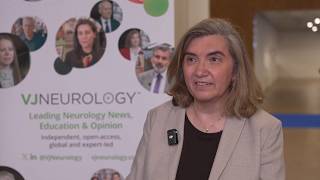
ACTRIMS 2026 | The complementary nature of iPSCs and animal models in MS research
Valentina Fossati, PhD, The Jackson Laboratory, comments on the complementary nature of induced pluripotent stem cells (iPSCs) and animal models in multiple sclerosis (MS) research. Dr Fossati highlights that iPSCs are reductionist models that can exclude confounding factors and focus on cell-autonomous effects, while animal models provide a more comprehensive in vivo picture. This interview is part of our coverage of the 11th Annual Americas Committee for Treatment and Research in Multiple Sclerosis (ACTRIMS) Forum, held in San Diego, CA.
These works are owned by Magdalen Medical Publishing (MMP) and are protected by copyright laws and treaties around the world. All rights are reserved.
Transcript
We often have the question on, you know, what is the difference between iPSCs and animal models? I really see them as two complementary tools. They’re very different and they address very different questions. You need an in vivo model, you need an animal model because of the complexity of the in vivo, right? Where you can understand that obviously, again, a disease is not just the brain, but it’s part of, especially in MS, where you have the immune cells migrating from the periphery...
We often have the question on, you know, what is the difference between iPSCs and animal models? I really see them as two complementary tools. They’re very different and they address very different questions. You need an in vivo model, you need an animal model because of the complexity of the in vivo, right? Where you can understand that obviously, again, a disease is not just the brain, but it’s part of, especially in MS, where you have the immune cells migrating from the periphery. So you need to have the big picture. On the other side, though, you know, and you imagine when your car is broken and you want to open the engine, you want to look piece by piece. And so you want to have more reductionist models in which you exclude any confounding factors. And this is something you cannot do in an in vivo model. In addition, instead, you can select one specific type. And so, for example, you can just take all the brain cells, you can recreate in a dish just the glial cells and the neurons, and eliminate any confounding effect that is due to inflammation, from migrating immune cells, and just look at cell-autonomous effects. So this will allow addressing, again, very different questions. And on top of that, you also have cells that have the genetic background of the individuals. This is a major point for all neurodegenerative diseases. We know that many neurodegenerative diseases have had a huge burden on our society, and they are increasing as society ages. And, you know, often you will hear people say we are not mice, right? And so the mouse cannot really depict or reflect the entire complexity of the genetics of the individuals, and in particular, the heterogeneity of the individuals. And so MS is in particular a disease in which every person has really his own journey, his own severity, his own response to the drugs. And this is largely due to all these genetic components. We’re now talking about SNPs variants. So these tiny polymorphisms, there are hundreds of them, and collectively create a balance of what is your risk and what is, again, the severity of your disease. And again, we don’t know many of them that we’re now discovering. We know a lot of them that are in genes, so in the sequences that codify for proteins. But there are a lot of also other regulatory sequences that we’re still largely unexplored. And that probably the balance of all these creates what is your unique journey to the disease. The iPSC modeling gives you now the opportunity to create in a dish, for example, oligodendrocytes, which are vulnerable cells or neurons which die in the disease and look for drugs and test them directly, to see which patients could be the best responders or the weakest responders. So this is a way of largely improving the preclinical phase by already generating information on how to design the clinical trial. So the idea is to use this iPSC modeling really robustly and in preclinical phases. So we expand that and we go on with only drugs that work at this stage. And so hopefully reducing the failure in the clinical phase, which is the most expensive one, which is the largest one, and where often, you know, over 90% of neuro drugs typically fail.
This transcript is AI-generated. While we strive for accuracy, please verify this copy with the video.
Read more...