ACTRIMS 2026 | The potential applications and future directions for iPSC models in MS research
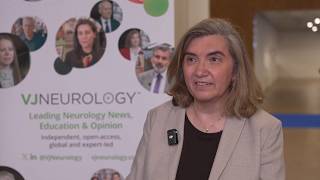
Valentina Fossati, PhD, The Jackson Laboratory, discusses the potential applications of induced pluripotent stem cell (iPSC) models in multiple sclerosis (MS) research. Dr Fossati then shares some of the future directions in this research, such as using these models to recreate the complexity of an MS lesion. This interview is part of our coverage of the 11th Annual Americas Committee for Treatment and Research in Multiple Sclerosis (ACTRIMS) Forum, held in San Diego, CA.
These works are owned by Magdalen Medical Publishing (MMP) and are protected by copyright laws and treaties around the world. All rights are reserved.
Transcript
We have now a cohort of different patient cells that potentially can be used for drug screening. And so the idea, especially my institute, NYSCF where we developed this automated platform, we are able to screen hundreds of different lines from different people at the same time. The idea of doing drug screening in these hundred different lines so that we can capture heterogeneity, we can capture the different response from each patient to the typical drug, because this is something that has been always known and is a challenge in the disease...
We have now a cohort of different patient cells that potentially can be used for drug screening. And so the idea, especially my institute, NYSCF where we developed this automated platform, we are able to screen hundreds of different lines from different people at the same time. The idea of doing drug screening in these hundred different lines so that we can capture heterogeneity, we can capture the different response from each patient to the typical drug, because this is something that has been always known and is a challenge in the disease. There is not one pill that works for all, you know, and especially MS patients know that, you know, some people have been working very happily with the drug, but not, you know, other people are not responding to that drug. And this heterogeneity has been a huge challenge in the MS field. And so the idea of now having a preclinical phase, not only data in vivo in the mice, but also complementing this data with already information on which drugs work on a specific subcluster of patients that will hopefully really much inform the clinical phase and create drugs that have more chance to succeed. It’s still a field in its infancy, and so these models, they need to be improved. For example, you know, we are not yet able to fully recreate the complexity of an MS lesion where you have the immune cells and the glial cells. But I’m very confident that, you know, many labs are working on it. We are working on it. So these models are becoming better and better as the years pass. And again, for now, this work on APS modeling in MS has been more focused on the progressive MS and on the intrinsic brain cells rather than the immunity and the peripheral cells, which is the target of traditional medications like disease-modifying agents. But I see again in the future working on creating more and more complex models that can incorporate also the part of the immune cells and really give us this disease model in addition, which we can make as complex as we want. And again, depending on the questions that we want to address. So we can remove a piece if we don’t want to look at it, add it back if we want to see the contribution of a particular cell type or not.
This transcript is AI-generated. While we strive for accuracy, please verify this copy with the video.
Read more...